


DONT UNDERESTIMATE THE POWER OF STRETCHING…

Whether you think its your age or all it took was bending over to pick up a pen from the floor – back pain can strike at any time and affects most of us at some point in our lives. Luckily most back pain is short term but if you are experiencing chronic pain you might benefit from making some everyday adjustments . Lifestyle has a massive influence on back pain and the good news is you can begin to take care of your back and help maintain a healthy spine by learning a simple back care routine that teaches you how to strengthen core muscles; improve flexibility and increase circulation to the spine and nerves.
Don’t underestimate the power of stretching – over time if we don’t stretch, our muscles shorten changing the position of our bodies and limiting movement. The result of this is changes in the way we walk or move; chronic stiffness; ligament damage and pain. In truth much low-level chronic inflammation isn’t related to your age but to the way you are using your body so its important to stay flexible to avoid back problems or if you are recovering from injury.
Remember, the soft discs between vertebrae dry over time, and less-supple discs can be more susceptible to bulging or rupture and put pressure on nerves, sending red-hot pain signals to your brain. But while getting older is inevitable, pain is not: Experts agree that routine stretching can both prevent and relieve symptoms. Try yoga poses that ease tension in your back, as well as in the hips, hamstrings and inner legs – all areas which can affect your posture and lower spine.
Multiple studies have shown that practices such as yoga which focus on stretching, strength and flexibility can reduce the amounts of pain medication required by those trying to manage chronic back pain.Whether your back pain is acute or chronic, do talk to your doctor before you start any new exercise routine. When you practice yoga approach each pose as a form of self-care: take it easy, be gentle and use deep, fluid breaths to move from pose to pose. If you feel any strain in your lower back reduce your range of motion or skip the pose.
Ardha Apanasana
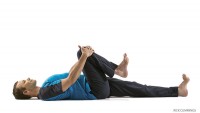
This pose stretches the body and eases tension in the lower back. Lie on your back. On an exhalation, draw your right knee toward your chest and hold your right shin with both hands. In this and the following 4 poses, do not press your lower back to the floor; instead, maintain a natural lumbar curve. Slowly inhale to release the right leg back to the floor, then exhale to draw in the left knee; inhale to release. Repeat, alternating right and left, 4 more times.
Supta Padangusthasana A
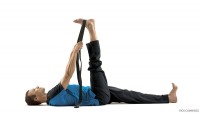
As well as stretching the hamstrings, calves and inner thighs this lovely pose can help alleviate stiffness in the lower back. Slide a hand under your lower back to make sure there is a gentle curve. Place a strap around the arch of your right foot. Exhale to straighten your right leg, stacking your ankle over your hip, or bringing your leg up as high as possible and slackening the strap as needed to feel a gentle hamstring stretch. Press through both heels, flexing your feet. Exhale to release and switch sides.
Cat/Cow
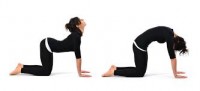
Increasing flexibility in the neck, shoulders and spine, this movement also stretches the muscles of the hips, back abdomen, chest and lungs. Starting in tabletop position on your hands and knees, alternate between arching your back and rounding it as you push down on the floor with your hands and tops of your feet. These postures help to massage the spine, while also stretching the back and the torso. These postures are a great way to keep the back limber—and happy.
Child’s Pose 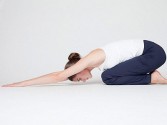
It may look like you’re resting, but child’s pose is an active stretch that helps elongate the back. It’s also a great way to de-stress before bed at the end of a long, exhausting day.
Try it: Start on all fours with your arms stretched out straight in front of you, then sit back so your glutes (bottom) come to rest just above your heels. Let your hips sink , relax and breathe in to your back and shoulders. Hold the position for 5 to 10 breaths, and repeat as many times as needed for a good, soothing stretch.
Downward Facing Dog
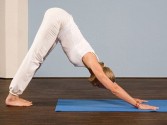
This classic yoga pose is a great total body stretch that targets back extensors, or the large muscles that help form your lower back, support your spine, and help you stand and lift objects.
Try it: Start on your hands and knees, with your hands slightly in front of your shoulders. Pressing back, raise your knees away from the floor and lift your tailbone up toward the ceiling. For an added hamstring stretch, gently push your heels toward the floor. Don’t worry if your hamstrings are tight – just bend your knees . Focus on opening and stretching the back of the body and relax you head and neck. Hold the position for 5 breaths and release back to your knees and rest in child pose for a few breaths before your final pose .
Viparita Karani
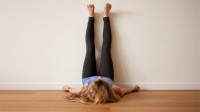
Legs Up the Wall Pose (or Viparita Karani) is a restorative yoga posture that allows the mind and the body to relax, relieving stress and tension. Its great for allowing the spine to relax and soften ; it reduces edema (fluid collecting in the cavities or tissues of the body) in the legs and feet ; it relieves tired leg muscles and gives you all the benefits of a yoga inversion whilst being one of the most approachable yoga poses as it doesn’t require much flexibility or strength. Even though it’s a passive pose, its benefits are pretty amazing.
Basically, Legs Up the Wall posture is exactly as it sounds! You lie on your back with your sit-bones as close to the wall as is comfortable for you. From there, you extend your legs up the wall, so that the backs of your legs are resting fully against it.For the most benefit, I generally like to recommend practising this pose for at least 10 to 15 minutes, but even just hanging out for a minute or two will suffice.
Once you are happy with these poses its possible to move on to basic core strengtheners and developing gentle twists.
Remember, back pain can be caused by many factors- from poor posture or misalignment to previous injury. or even too soft a bed! Its important to be gentle and ideally to find a yoga teacher who can help make sure you practice correctly and with care.
Namaste!

