


Well turns out no, it’s not. Yoga is becoming a serious cross training tool for anyone looking to reduce their risk of injury and improve performance. If you have ever taken a strong vinyasa class you’ll know that yoga can be a challenging work out in itself, but athletes like Andy Murray and Cadel Evans have found that yoga not only elongates tight, shortened or fatigued muscles but also brings clarity and focus to the mind.
Millions of us practice a variety of sports every week and we know that we don’t have to a have an Olympic training schedule to injure ourselves. The trouble is, because a particular sport can develop certain muscle groups while ignoring others, over time, this process causes imbalances in the muscles and joints, leading to overuse injuries and poor performance.
Common injuries often directly linked to lack of flexibility, poor core strength and misalignment include those involving the illiotibial band (ITB), knee, hamstrings, hip flexors and shoulders. Even if you stretch pre- or post-workout, athletes usually just stretch the muscles in the same direction and plane of motion in which they will be exercising.
BOOK YOUR PLACE ON OUR WORKSHOP NOW
The workshop will be held at our studio in Selham on Saturday 27th May (10.00 -12.45) and you can book on line by clicking the link below.
Please note spaces are limited.
Cost is £30 per person with
https://v1.bookwhen.com/schedule/9e9bu
What does Yoga do that’s different?
Yoga helps the muscles, tendons, and ligaments move through a full range of motion, cultivating balance and core strength. It is distinctly different from other kinds of exercise as it generates motion without causing strain and imbalances in the body, making it an ideal complement to other forms of exercise and a pretty extreme advantage to any sport.
The “asanas” are the physical positions that co-ordinate breath with movement and we hold these positions to stretch and strengthen different parts of the body. They systematically work all the major muscle groups, including the back, neck, and shoulders, deep abdominals, hip and buttock muscles and even ankles, feet, wrists and hands.
Although most poses are non aerobic in nature, they do in fact send oxygen to the cells in the body by way of conscious deep breathing and sustained stretching & contraction of different muscle groups and this invariably improves joint and muscular flexibility and strength. Crucial to the body’s overall structural soundness, yoga practice checks any imbalance in muscular development and enables the body to function more efficiently.
What does all of that mean?
Enhanced joint and muscle pliancy translates to a greater range of motion or an increase in the performance latitude for a particular movement or series of movements – a swimmer with supple shoulder and hip joints is able to capture and pull more water than a swimmer with a more limited range of motion. What it means is your body is equipped to perform better with less risk of injury.
If you thought that yoga was simply sitting cross legged surrounded by incense its time to take a fresh look at what yoga really can offer todays athlete. We’ve teamed up with sports massage & injury specialist Nicola Donnelly-Clark for a morning workshop to help you reduce the risk of injury and improve performance & flexibility.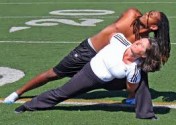 It doesn’t matter if you have no yoga experience or how flexible you are, this workshop is designed to give you tips and strategies for the way your body is now.

